ADR Documents Explained: Required Paperwork for Dangerous Goods Transport
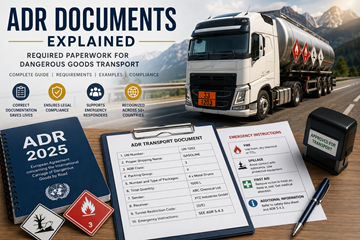
Incorrect or missing ADR documentation can lead to shipment delays, heavy fines, transport bans, and serious safety risks. In this complete guide, we explain ADR transport documents in simple terms, including required information, legal requirements, examples, and practical compliance rules for dangerous goods transport in Europe.
What Are ADR Transport Documents?
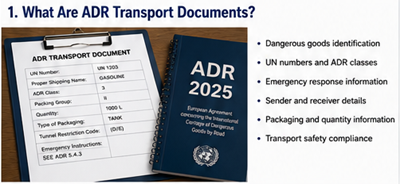
ADR transport documents are official documents required during the transport of dangerous goods by road. These documents identify hazardous materials and provide important safety and emergency information.
ADR documentation helps drivers, transport companies, inspectors, customs authorities, and emergency services understand the risks associated with transported cargo.
- Dangerous goods identification
- UN numbers and ADR classes
- Emergency response information
- Sender and receiver details
- Packaging and quantity information
- Transport safety compliance
Why ADR Documentation Is Important
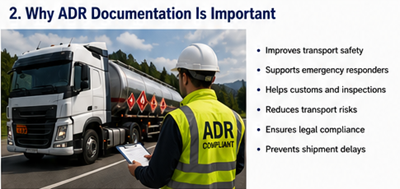
ADR documentation is essential for transport safety, legal compliance, and emergency response operations.
Without proper dangerous goods paperwork, emergency services may not know what substances are involved during an accident, leak, or fire.
- Improves transport safety
- Supports emergency responders
- Helps customs and inspections
- Reduces transport risks
- Ensures legal compliance
- Prevents shipment delays
Which Information Must Be Included in ADR Documents?
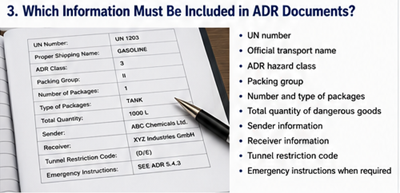
ADR regulations define specific information that must appear on dangerous goods transport documents.
- UN number
- Official transport name
- ADR hazard class
- Packing group
- Number and type of packages
- Total quantity of dangerous goods
- Sender information
- Receiver information
- Tunnel restriction code
- Emergency instructions when required
All information must be accurate and clearly readable during transport operations.
What Is a UN Number?
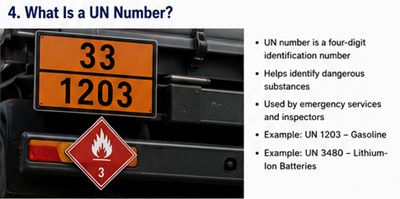
A UN number is an internationally recognized four-digit identification number assigned to dangerous substances and hazardous materials.
UN numbers help emergency services and inspectors quickly identify dangerous goods during transport.
- UN 1203 — Gasoline
- UN 3480 — Lithium-Ion Batteries
- UN 1011 — Butane
- UN 1090 — Acetone
- UN 1830 — Sulfuric Acid
- UN 1789 — Hydrochloric Acid
ADR Hazard Classes in Documentation
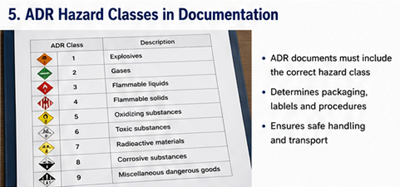
ADR transport documents must include the correct ADR hazard class for every dangerous substance.
- Class 1 — Explosives
- Class 2 — Gases
- Class 3 — Flammable liquids
- Class 4 — Flammable solids
- Class 5 — Oxidizing substances
- Class 6 — Toxic substances
- Class 7 — Radioactive materials
- Class 8 — Corrosive substances
- Class 9 — Miscellaneous dangerous goods
Correct ADR classification determines packaging, labels, transport procedures, and emergency requirements.
Packing Groups Explained
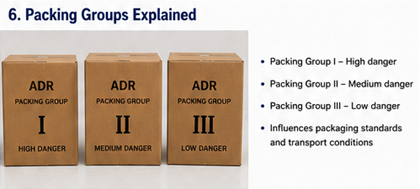
Some dangerous goods are assigned packing groups indicating the level of danger associated with the substance.
- Packing Group I — High danger
- Packing Group II — Medium danger
- Packing Group III — Low danger
Packing groups influence packaging standards, transport conditions, and handling procedures.
Emergency Instructions and Safety Information
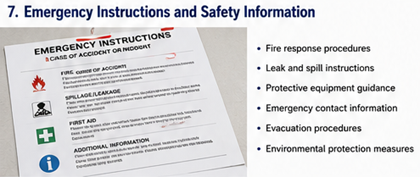
ADR transport operations may require written emergency instructions explaining what drivers and emergency responders should do during accidents or dangerous situations.
- Fire response procedures
- Leak and spill instructions
- Protective equipment guidance
- Emergency contact information
- Evacuation procedures
- Environmental protection measures
Who Is Responsible for ADR Documentation?
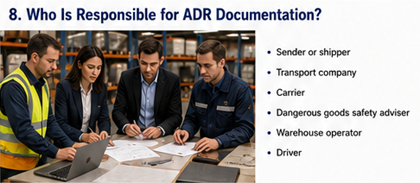
Several parties may share responsibility for ADR transport documentation depending on the shipment and logistics operation.
- Sender or shipper
- Transport company
- Carrier
- Dangerous goods safety adviser
- Warehouse operator
- Driver
Incorrect paperwork may create legal liability for multiple parties involved in the transport chain.
ADR Documents During Roadside Inspections
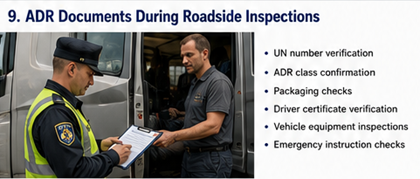
Transport authorities regularly inspect ADR vehicles and dangerous goods paperwork during roadside controls.
- UN number verification
- ADR class confirmation
- Packaging checks
- Driver certificate verification
- Vehicle equipment inspections
- Emergency instruction checks
Missing or incorrect ADR documentation may result in fines, delays, or vehicle immobilization.
Digital ADR Documents and e-CMR
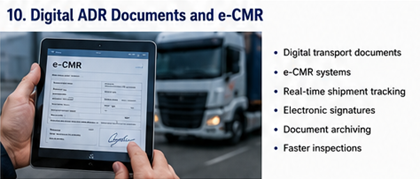
Modern logistics companies increasingly use digital ADR documents and e-CMR systems to simplify dangerous goods transport management.
Digital documentation improves operational efficiency, document tracking, communication, and compliance management.
- Digital transport documents
- e-CMR systems
- Real-time shipment tracking
- Electronic signatures
- Document archiving
- Faster inspections
Official ADR Documentation Sources
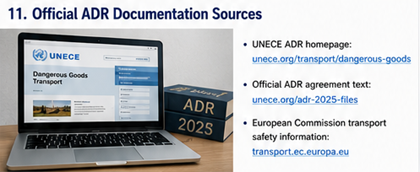
Official ADR regulations and dangerous goods transport documentation requirements are published by the United Nations Economic Commission for Europe (UNECE).
- UNECE ADR homepage: https://unece.org/transport/dangerous-goods
- Official ADR agreement text: https://unece.org/adr-2025-files
- European Commission transport safety information: https://transport.ec.europa.eu/
Common ADR Documentation Mistakes
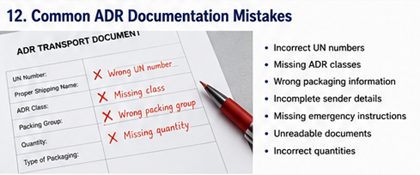
Incorrect ADR paperwork is one of the most common dangerous goods transport violations in Europe.
- Incorrect UN numbers
- Missing ADR classes
- Wrong packaging information
- Incomplete sender details
- Missing emergency instructions
- Unreadable documents
- Incorrect quantities
Careful documentation management helps companies avoid penalties and improve transport safety.
Conclusion
ADR transport documents are essential for safe and legally compliant dangerous goods transport across Europe. Correct documentation helps identify hazardous materials, supports emergency response operations, improves transport safety, and reduces operational risks.
As dangerous goods logistics continues evolving, digital ADR documents and e-CMR systems are becoming increasingly important for modern transport companies and logistics platforms.
Frequently Asked Questions About ADR Documents
What are ADR transport documents?
ADR transport documents are official dangerous goods paperwork required during hazardous materials transport by road.
What information must ADR documents contain?
ADR documents usually include the UN number, official transport name, ADR class, packing group, quantity information, sender and receiver details, and emergency instructions.
What is a UN number?
A UN number is an internationally recognized identification number assigned to dangerous substances during transport.
Who is responsible for ADR documentation?
Responsibility may involve the sender, carrier, transport company, warehouse operator, dangerous goods safety adviser, and driver.
What happens if ADR paperwork is incorrect?
Incorrect ADR documentation may result in fines, shipment delays, transport bans, legal liability, and safety risks.
Are digital ADR documents allowed?
Yes. Many logistics companies now use digital ADR documents and e-CMR systems for dangerous goods transport operations.
Where can companies find official ADR rules?
Official ADR regulations are published by UNECE and are available through the UNECE dangerous goods transport website.
eXus Dev